Search Novice

We're all searching for something.

26 October 2007

Special Y! Ads Still Showing Up

I was just watching the morning news programs and happened to see an ad for Special K (the cereal), which at the end tells the viewer to go to Yahoo! and search for [special k] for more information. So, naturally my first impulse was to get back to the blogosphere and post.

Here are some comments from other bloggers about the ad campaign, which I'm dubbing "Special Y!".

Special K - special idea - Residual Media
Is Yahoo Selling Out? - Scott Hendison
Just What Kind of Ads are Running on Yahoo? - CenterNetworks

The biggest concern among these writers seems to be the fact that the ads that appear do not have the expected shaded box around them, so it doesn't follow Yahoo!'s usual method of displaying sponsored results. Therefore, the concern is that users are likely to not realize the ad is an ad.

However, my main interest would be to see if there is any research out there that shows the success (or failure) of the TV ad campaign in getting people to the web. It's interesting - usually, TV ad campaigns have 1 goal - get people to buy the product. With this one, we still have that goal as the primary one, but we also have another one in the effort to get Special K's people to Yahoo!'s website.

I would really like to see some research showing traffic increases or decreases after the placement of this tv ad. Do traditional media advertisements have the ability to get people to use new media, search, social media, etc?

Labels:

06 September 2007

How Search Engines Will Grow

SEOmoz | Where are Search Engines Most Likely To Innovate?

Above is a very quick and interesting look at how search engines might change and grow over the coming years, posted by Rand over at SEOmoz.

Personally, I see vertical search as the area with potential that has been developed the least, and therefore has the most potential for growth. I say this with sites like Magicyellow.com, Yellowbook.com, and ServiceMagic.com in mind, because these are the big players in the game of "who-ya-gonna-call" in the online world. These are the cats throwing the most money into offline advertising and branding, in efforts to push people onto their sites and use their listings.

Basically, these sites are also the reasons that I say the area is under-developed. Case in point: if you need a plumber, and you want to find one online, these days you go to Magicyellow or Yellowbook (or place your own home-service-related website here). You plug "plumbers" into the search box, along with a location, and press Enter, and you are given a results page that has a long list of plumber-related services.

Sidenote: if you're on Magicyellow, you're only given a list of the categories that most closely match your search. Do you want "plumbers" or "Plumbing Drain & Sewer Cleaning"? Will one give you better results because it sounds more specific? Are they really different categories, or just different names listed for the same group of businesses? In spite of the poor interface, I click on "plumbers"... and get a page full of ads! What's the difference between "Premier Advertisers", "Preferred Advertisers", "Sponsored Listings", and "Courtesy Listings"? Did the courtesy listings people pay to get their business listed, or are they provided as a "courtesy" of some sort?

Anyway, when you do get to the list of plumbers, there is no added value - the experience gives you the same benefit as looking up plumbers in the phone book (on paper!). There's a list of companies, and you still have no idea which is best for you. As I said, you might as well just open the phone book.

And don't get me started on sites like ServiceMagic. Here, you don't even get to look at the list - you have to submit your personal information into cyberspace, then wait while the website contacts plumbers "for you". Are you kidding? That's not the internet! That's not what the internet is supposed to be. I want to pick the service myself! I can be my own 411 - just give me the required information!

More on this later... I'm at work, and this is starting to take up more time than I thought it would.

Labels: , , , ,

18 June 2007

The Death of SEO?

A very interesting article by Mike Grehan over at ClickZ:
SEO Is Dead. Long Live, er, the Other SEO

Mike waxes for a while in this one about the "death" of SEO, or, more specifically, the death of SEO as we know it. Perhaps this "death" will also be a way for SEO to catch up with the technology of the current day. Mike points to Ask.com several times in this article, saying that their 3-column approach has basically turned the SERP into a virtual portal on the information searched for. He's right, and he may also be right about this being the future of SERPs.

If it is, then we may see Google follow suit and ditch the adwords column on its SERP in favor of a 3rd column displaying more universal search (US) results. However, since Google rarely seems to follow trends that it didn't start in this industry, I wouldn't hold my breath. It's just possible, that's all I'm saying.

One question to ask is, if Google and other SEs did go to the 3-column SERP, what would be the future of adwords-type advertising? Where will it go on the page? If you view this Ask.com SERP, you can see only one sponsored link, for Target.com, who obviously paid a lot of money to get their link right in the center of the page. If you actually go to page 2 and following, it's at the top of each page.

I've actually thought that Google's layout for US SERPs was lacking something, and now that I've taken a decent look at the Ask.com SERPs, I think the 3-column approach is where they should go if they want to improve it. I look at this SERP from Google, and I have to say that Ask has the upper hand. I see a lot of white space - that could be used just to drive revenue (adwords), if not for US results. The US results are there, but it's at the expense of traditional results, which I don't think is the answer.

Labels: ,

30 May 2007

The Future of Search - Personalization

Here are two links:

Official Google Blog: Putting Users In Charge

Financial Times: Google's search policy puts the user in charge, by Peter Fleischer

These are links to one Googler exercising some educated speculation about where the future of search (and Google) might lie. Basically, the article on Financial Times website is about how personalization is really the key to the future of search. If search algorithm is not built to remember a user's preferences and history, we can only take search so far. By producing universal results that are the same for everyone, we're never going to solve the problem of intentions behind the search phrases. For example, when someone searches for "Paris", are they searching for the city or Paris Hilton? Nobody really knows, but we will probably have a clue if we know the person.

What if they are looking for pictures of Paris, France? An image search for "Paris" brings up just as many pictures of the woman as the city. Of course, we all know how dangerous an image search can be for any phrase, especially if conducted in a work environment. Just spend a few minutes using city names as search phrases in Google image search.

But that aside, what is this going to mean for the future of the SEO industry? Right now, SEO involves aiming at SERs that are absolute. For example, someone searching for “Paris” in Bogota will see the same thing as someone in Miami searching for the same phrase. However, if SERs suddenly become relative to the user’s preferences and history, the user in Miami might see different results based on his/her perceived age (past searches for myspace, facebook, or other social websites), entertainment savvy (past click-thrus to EntertainmentWeekly.com), or other personal web surfing habits. The user in Bogota may be a college professor (past visits to Google Journal Search, Google Book Search, and click-thrus to university websites). This is similar to the philosophy of Amazon.com’s algorithm, which has been profiled in several new stories as a seriously intelligent marketing machine, remembering users’ past behavior and recommending new products accordingly.

The foremost question for SEOers is, how are we going to optimize pages if we don’t know what users are going to see on the SERPs? How much business are our clients going to loose because of this, and will it outweigh the business that they stand to gain?

But another question is, how is this going to affect advertising on SEs? If I want to make a bid on a phrase on Google adwords – for example, “Paris” – how can I be sure that Google is giving me a proper ROI if some people who type in “Paris” are going to see different things than other people, based on their usage history? On the other hand, will this greatly improve the quality of the impressions I get, when I do get impressions? Will the viewers be more likely to be interested in my ad, if Google is sure that their past usage indicates an interest in the subject matter?

I think I’ve just formed two complete paragraphs with nothing but interrogatives. I’m sure there is a grammar rule against that.

Labels: ,

21 May 2007

The Future of SE Advertising

With the advent of US, I am wondering what the evolution of paid ads will look like. It seems to me that US will change the visibility of paid ads in the future, since it alters SERs. Second search and US capability are going to make it commonplace for the SE to show the results for the requested search, as well as the results for a more useful search - which, hypothetically, the user would have requested in the first place, if they knew what they were doing. Since we're speaking hypothetically, my hypothesis is that, once US and Second search get going, the SE will start to show ads for the keywords that are deemed "more relevant." Why wouldn't they? If I've got a phrase that I think the user is going to find more useful than the phrase he requested, why wouldn't I display more useful ads, if I thought I could?

Just to make sure everyone understands what I'm talking about, the fallout from this would be that the advertisers who bought keywords matching the less helpful phrase would receive lower placement than the ones who bought keywords matching the more helpful phrase. So, if I, the user, search for [travel northeast], and the SE thinks that a search for [airfares new england] would be more useful, then the ads shown would match [discount airfares...], instead of [travel northeast]. The ads that are most likely lucrative for the SE and the advertiser would be the ones judged as most relevant, in my opinion, meaning that the ads matching the Second Search - not the intended search - will receive higher placement.

Of course, that's just my opinion. You are free to disagree.

Labels: ,

20 May 2007

Universal Search - the best answer

I've been planning for a few days to post about Google's announcement that the next big thing is the so-called "Universal Search." This is the holy grail, judging from posts on Google's official blog. We insiders are excited about Universal Search as only geeks can be. But the Googlers in particular should be excited; after all, it is best answer. The best answer is always the best answer.

I would say that I noticed the changes in Google's UI before I read about Universal Search (US). Here's a quick look at the new SERP:


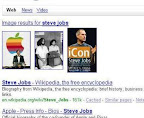
Click on the image for a larger size. Basically, in the SERP for [steve jobs], the Google team has managed to squeeze image results and natural results, as well as links near the top to News and Video, where there would also be pertinent information about Steve Jobs. A small change, but a change, nonetheless. However, if we were to look at another search,


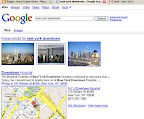
This time for [new york downtown], notice that there are image results first on the SERP, then a map, and then the natural results come later. This is useful for searches involving place names, which would be better suited for a map search anyway, and are probably tried by less experienced users. This is serving Google's goal of being the one-stop-shop for information for anyone - web savvy or not.

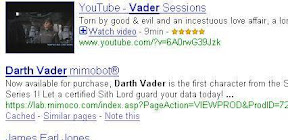
Now look what creeps into the SERP for [darth vader]:


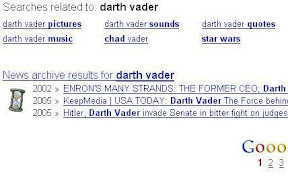
There's a Google video result, about halfway down the first page. The video result would not be as highly ranked, except that Google's new US algorithm judged the video to be just as relevant as the 5th or 6th natural result. Then notice at the bottom:


We've got news results at the bottom of the page as well, in addition to related searches that might be just as useful as the user's intended search phrase.

These are just a few examples to show what Google is striving toward - a truly comprehensive information search, that will let people from all demographics find the information they need, regardless of which search engine or portal they use. Eventually, if US becomes fully developed, people will no longer be limited to a certain type of information when they search. No longer will people need to go to JStor find scholarly publications, or to a news search for current events. After all, if a general search engine has so many categories it is limited from searching, how can it really be comprehensive?

Labels: , ,