Search Novice

We're all searching for something.

25 September 2007

Google Goes Outside

Google Uses Outdoor Billboards To Promote Goog411

Interestingly, Google has chosen to use outdoor billboards for initial promotion of its new 411 service. We'll see if this proliferates. Currently, I get the feeling that if you're not online very much, you don't have the same perception of the Google brand as you would if you were constantly surfing the web.

This has significant implications for the over-40, rural demographic that probably doesn't spend that much time perusing websites or buying adwords. Are those the people more likely to use 411? Or, as SELand observes, is this completely a location thing, an attempt to get people's attention when they're at the place where they're most likely to use 411?

I think it's a mix. Those getting their direction from billboards are more likely to be older, less online-savvy users, and therefore Google wants to not exclude those people. However, billboards are probably also more effective media for 411 ads, simply because of their location - people see them while in cars, which is the time when they're most likely to use 411.

Labels:

Google News Indexing Ads On UK News Site

Google News May Index Your Ads

SELand noted today that Google News has been indexing a certain Nationwide ad ("Nationwide" the insurance company) in actually SERP listings for news titles. It's very interesting, and bad, but for some reason the text of the ad is showing up under headlines on the SERP for things like the UK kidnapping of Madeleine.

I don't think this is a widespread danger, because it's only happening for one site - InTheNews.co.uk. Anyway, there is something screwy about the way that Overture has chosen to display the ads on the site's pages. It just doesn't seem like a good design choice. Plus, the width of the ad has made a scroll bar necessary in my browser. Check it out.

Labels:

20 September 2007

Google Acting Screwy

Just now, I was trying to view the Adwords campaigns that I'm managing, and I got a page with the following message from Google:

The AdWords account interface is temporarily unavailable due to system maintenance. AdWords is expected to be down from approximately 10:00 AM until 2:00 PM PDT [?] on September 8, 2007. Please note that your campaigns will be running normally during this short period of downtime, which only affects your account management pages. We apologise for any inconvenience.

It's probably nothing, but I just thought it was worth noting, since today is September 20th.

Labels: ,

07 September 2007

Selling Links what the worst that can happen

Selling Links what the worst that can happen

All I can say is, Dave, please read your posts before we do. That title doesn't even make sense!

He does raise some good questions, as always, though.

Labels: ,

05 September 2007

What You Say Is As Important as What You Pay

What You Say Is As Important as What You Pay | Modern B2B Marketing Blog | Marketo

This is a very interesting, and brief, post about the importance of targeted landing pages. I was very surprised to learn that only a quarter of all PPC ads take users to targeted landing pages.

Labels: ,

22 August 2007

Print vs Silicon

A few times a month, I don't have time to read a really interesting article that shows up in my feed reader, so I go to the website and print out the article for reading later. I've definitely noticed that once I do that, it usually takes me 2, maybe 3 days to finish reading the article, and I generally read everything in the article. My behavior with reading articles on my computer screen is much different - I rarely read every word (or paragraph even), and I never leave the article until later, if I do decide to read it. Without delving too deeply into the issue (I'm pressed for time), I'm just wondering what the real causes are for the differences in behavior. Thinking of the two situations even more, I realize that I'm fairly likely to click on ads online, whereas I hardly ever pay attention to advertisements in a newspaper or magazine. There definitely are opportunities for exploiting such behavior for gain.

Labels: ,

13 August 2007

SEOmoz Gets It Right, But Also Gets It Wrong

To begin, let me say that, while I have been posting, I have gotten busy and fallen behind on my reading. So my posts have not been much more than, "hey, look at this article." I haven't had much to say that's been my own.

However, today, I've got to say something about this article over at SEOmoz. I'll try to keep it short...

SEOmoz | The Economic Motive Behind Google's New Advertisement Algorithm

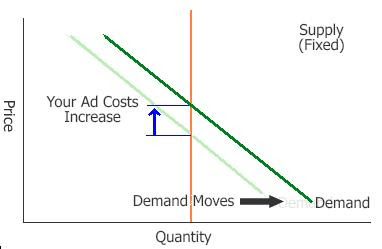
This article is of great interest to me, since I was once an Econ major in school. Rand gets the overall idea right by saying that demand has shifted solely because of Google's change in its ad formula. However, his graph is wrong.


He says that demand moves to the right, and he is correct.
However, this is what the graph ought to look like:


Supply does not change - it is the same no matter what demand is. In Rand's graph, supply has actually increased with the new demand, which would mean that there would be more advertising slots to sell than there were before. But in actuality, the supply of ad spots - or Impressions - did not change. There are still just 3 top spots - same as before - and 10 to 12 spots on each SERP.

Most people want to at least be on the first SERP, so that would mean that on each serch, there will also be only 3 top spots at the most, plus an additional 9 or 10 spots - a maximum total of 13. That will never change, unless Google overhauls its format.

So, supply is vertical. It never changes, which means that small changes in demand will significantly affect the price, as we will see here.

Labels: ,

07 August 2007

FT article: Online ads will overtake newspapers in US by 2011

Financial Times: Online ads to overtake US newspapers

This article foretells something we all know is coming sooner or later. However, I wonder how the paper's source, Veronis Suhler Stevenson, came to conclude that we would have to wait 4 more years to witness this eclipse. It seems the prediction is based on the fact that growth in online ads has averaged 21% annually.

But if this has been the average growth, who's to say the revenues will increase uniformly along that 21% line? I would think there will soon come a "tipping point," after which we will see the vast majority of serious players shift the bulk of their advertising dollars to the online market. If that were the case, the growth could go to 25%, then balloon to 30, then to 40, and so on. And if so, we could see online ad spending eclipse the old newspaper guard somewhere within the next 2 to 3 years.

However, either way, we are probably only talking about a maximum difference of 12 to 18 months. The point is definitely that the shift is coming, whether it happens 2 years from now or 4 years from now. The important thing is to anticipate it, and use any foreknowledge to jump ahead of your competition.

Labels:

02 August 2007

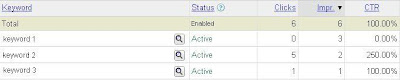
Google Adwords statistics are going haywire!

Take a look here:


That's right, it says that I actually got more clicks than impressions! 5 clicks, in only 2 impressions, which makes up for the 0 for 3 on the first keyword!

Man, I must have been doing something right when I picked that keyword.

In case you're interested in actually using adwords, take a look at this latest post on the Adwords blog about the new Search Query Performance Report. It's a good addition, which should have been made long ago.

Labels: , ,

25 July 2007

WebAnalyticsDemystified Report Says "Spend Your Money!"

New Report from WebAnalyticsDemystified [SearchEngineWatch]
WebAnalyticsDemystified: The Problem with Free Analytics

Over at SEWatch, they posted yesterday about this report, put out by WebAnalyticsDemystified, which talked about the "problems" associated with free analytics. More properly, the report ought to be titled so that its subject matter is made more clear: the report actually exposes some of the problems with how free analytics programs are used. It doesn't delve into any conspiracy theories about Google using all the data collected by Google Analytics, or anything like that. It just says that companies not willing to spend the money on analytics software are less likely to see high ROI on the money they spend paying an employee to track their website with free software.

*ahem*... Well, duh!

One thing I noticed in the findings of the report that seemed screwy was their finding about ad-hoc usage. According to the report,

"35% of free analytics users reort only an ad-hoc use of the tool, as opposed to less than 20% who used a paid for solution."


Hmmm... Did that say 20%? Obviously, if you don't pay anything for a piece of software, you're going to be less likely to use it in a productive, systematic way. I'm not surprised by the 35% number. But 20% of paying users report "ad-hoc" usage? That's atrocious. And, since the number is so large, I don't think it helps them prove their point. Rather, it just shows that most people out their don't have a very good idea of how they should use their analytics software, including those who pay for it. I would never have thought that 20% of people paying for web analytics would report just ad hoc usage. Shows what I know...

Labels:

18 July 2007

Adwords reporting is ever more useful

Inside AdWords: Discover your share of voice with Impression Share reporting

One of the problems I had while doing initial research prior to starting my company's Adwords campaign was finding out how many searches keywords actually get each day/week/month. If the keywords don't receive significant traffic, which is usually the case for keywords that are regionally focused, it is often hard to find traffic statistics.

Here's an example of my dilemma. The number of people searching for [used cars] is going to be immense across the whole country. Bob Smith's Used Cars in Des Moines, IA, is not going to really benefit from bidding for that keyword phrase. He would benefit from bidding on a phrase that was obviously aimed at finding used cars in the Des Moines region. However, traffic on [Des Moines used car dealers] is going to be substantially less than [used cars], which is good, in this case. Bob wants to draw from the subset of people looking for the latter keyword, and he doesn't want to mess with anyone searching for the former.

However, what if the town is substantially smaller - like, say, a suburb of a metro area? What if you wanted data on keywords related to convenience stores in Riverdale, Maryland? I doubt you can find much data using whatever tools are available to the general public. Wordtracker and Overture will probably tell you there's too little data to make a calculation.

But now, I can use the Google's Impression Share data to see how often my ad is displayed compared to the total number of available impressions in the market. This gives me an exact idea of how much traffic my keywords get each day, which is exactly what I wanted on the front end. Yes, I did have to actually put the money down first in order to get this data, but it's still a valuable metric to have, and it helps me know what I had wanted to find out originally.

Labels: ,

17 July 2007

SEOmoz | The AdWords Ad Optimization Process - Little Changes Have a Big Effect

SEOmoz | The AdWords Ad Optimization Process - Little Changes Have a Big Effect

A great post from Rand at SEOmoz about some basic paid search campaign strategies.

Labels:

06 June 2007

Ask.com: The better marketer

Take a look:

ClickZ News - Yahoo Shows Off Panama
PC World - Yahoo Opens Access to Panama
SEW Blog - Ask.com: The Other Search Engine

Does anyone see a dichotomy here? What we have is a whole bunch of people that want to throw Google off of their thrown. We've got different news stories, all asking the question, "Is this going to be the thing that enables [Insert Company Name] to catch up with Google?"

However, the story about Ask.com is very interesting, because it shows a company that seems to be openly embracing its standing in the marketplace, behind Google and the other search engines out there. They're not content with their standing, but in order to move up in the world of search, they are openly acknowledging that they are not number one, or even number two for that matter. Perhaps this line of thinking will help them better identify with the majority of users out there, who also designated Google as the SE to beat. Ask.com seems to further feed this line of thinking by advertising on YouTube, a Google-owned property.

Yahoo, on the other hand, like Microsoft, is continuing with the more traditional approach of pointing people to itself as the best search engine out there. Of course - why wouldn't they want people to think they are the best? The problem with that is, most people don't. They've got a larger network, perhaps more tools, and a different ad platform now, but everyone still says Google is better. That perception doesn't seem to be changing soon, either.

This is all to say that, while Yahoo and Microsoft seem to be taking the old, traditional approach to marketing themselves, it doesn't seem to be working, and Ask.com's approach seems to be more in line with the users out there.

Labels: , , ,

21 May 2007

The Future of SE Advertising

With the advent of US, I am wondering what the evolution of paid ads will look like. It seems to me that US will change the visibility of paid ads in the future, since it alters SERs. Second search and US capability are going to make it commonplace for the SE to show the results for the requested search, as well as the results for a more useful search - which, hypothetically, the user would have requested in the first place, if they knew what they were doing. Since we're speaking hypothetically, my hypothesis is that, once US and Second search get going, the SE will start to show ads for the keywords that are deemed "more relevant." Why wouldn't they? If I've got a phrase that I think the user is going to find more useful than the phrase he requested, why wouldn't I display more useful ads, if I thought I could?

Just to make sure everyone understands what I'm talking about, the fallout from this would be that the advertisers who bought keywords matching the less helpful phrase would receive lower placement than the ones who bought keywords matching the more helpful phrase. So, if I, the user, search for [travel northeast], and the SE thinks that a search for [airfares new england] would be more useful, then the ads shown would match [discount airfares...], instead of [travel northeast]. The ads that are most likely lucrative for the SE and the advertiser would be the ones judged as most relevant, in my opinion, meaning that the ads matching the Second Search - not the intended search - will receive higher placement.

Of course, that's just my opinion. You are free to disagree.

Labels: ,

17 May 2007

Helping us get our Google on

Google just announced "Second Query" improvements to its search, to which I can only say, "awesome." The new improvements will launch a second query when a user performs a search, if it judges that the user could get more relevant results with a related (second) query. The SERP will then show the results of both queries, giving the user better results.

Perhaps more impressive are the new translation improvements, which will allow Google to translate a query into another language, find results, and then translate those results into the original query language to present to the user.

I think we know that the big wigs at Google and Yahoo are trying to build their search engines so that when grandma tries to search for "gold diamond ring," she gets exactly what she's looking for. It all depends on how they structure the SERP, but this is most likely going closer to that goal.

My question is, "what is this going to do to ad placement?" If you bought a top placement for the 1st query, will your placement be affected because Google judges that a 2nd query would have given the user what they wanted?

Conversely, what if you buy top placement for the 2nd query? Will your results get top billing now, or will the ones from the 1st query get to pull rank?

My gut says that the ads shown will be ones most relevant to the 2nd search. If Google has the opportunity to show ads that are more relevant, then I don't think they are going to pass it up.

Labels: , ,

09 May 2007

Google's taking over the newspapers now!

From Search Engine Watch Blog...
---------------------------------------------------------------
Google Print Ads Now in AdWords Console

Andy Beal at Marketing Pilgrim has posted screenshots of the new Google Print Ads interface in the AdWords console. Google announced last month that the program would enter an extended beta this month.

The new tab offers advertisers the ability to buy print ads in participating newspapers, including the New York Times, Chicago Tribune, and LA Times. The console includes a date range for the campaign, weekly budget, and the ability to select newspapers by schedule, circulation, or relative cost.

----------------------------------------------------------------


So what's next?
I think that Google ought to just buy a bunch of little newspapers. That's right - little, suburban newspaper firms that aren't relatively expensive to buy up. For 3 billion dollars, they could probably buy up an entire metro area... or the eastern seaboard. I haven't done any concrete research on the value of small newspaper firms. But anyway, here's the scenario:


  1. Buy 100 newspapers in the same state, MSA, or CMSA.
  2. Consolidate the advertising divisions of all 100 of them.
  3. Consolidate printing of the newspapers.
  4. Sell the ads online mostly, through an auction-based, adwords-style system.
  5. Now that they are all printed at the same place, and Google owns the whole operation, the newspaper ads can be printed alongside articles with high keyword relevance. Ads can be run throughout all the newpapers, instead of clients having to decide which individual newspaper they want to run an ad in. Since these papers cover an entire region, the ads will be run in the most efficient way, across the entire region.
  6. Watch public opinions change, as people are slowly brainwashed by inundation with ads.
  7. Keys to the city are given to Google.


I thought it was kind of interesting, for a theory. Anyway...

Labels: ,

Why list your phone number in adwords?

I posted this in the main Google optimization forum at SEO Chat, with no response, so I'm posting this here, hoping some more interested people will see it and respond...

To anyone who feels inclined to answer:

I was doing some research for my company yesterday morning, and noted that some firms advertising on Google have opted to place a phone number in the ad text.

For example, in a search for "riverside ca plumbing", I noticed the following ad:


Need a Low Cost Plumber?
Midtown Rooter Plumbing. Call Now
818-555-5555 - 24 Hour ER Service
----URL address-----
Los Angeles, CA

There were several others like this in other searches that I tried, and most of them seemed to be from companies that are one-man-shows or at least pretty small.

My questions:

  1. What are the benefits/drawbacks of putting a real phone number in the actual ad text?
  2. Why doesn't Google block this? Or, can they even?

It seems to me (a) that, from a web design perspective, this would defeat the purpose of advertising on Google, since people might be "converted" without actually clicking on the link, and so your click-thru reports would not actually show the real success of the ad. I would think that any web designer would never practice something like this, if they valued the future of their career.

Also, (b) it seems that this is a way for the business owner to get around paying for all the customers he gets through the ad, and therefore Google ought to block this practice if they can.

Any thoughts?

Labels: , ,