I apologize for the absence. The Independence Day week has taken me to several locations around the southeast, most notably Lake Junaluska, North Carolina - a place that is, in the words of one Anglican minister, "not far from the heart of American religion." Family reunions are fun, even when you're still just getting to know everyone (I'm married in).
Anyway, back to a subject that is more relavent to this blog. Blogging. Due to my week-long absence, and my recent business at my job, I have been left with very little time to devote to other things, including posting on this blog. Not surprisingly, the traffic on the site went down very near to zero during the past two weeks, and I have had no comments to moderate.
So I think the take-home point is very clear:
frequent posting is essential to improving traffic on your blog. Of course, other things are also equally important, but everyone needs to be clear that there is no reliable way to gain readership without also providing fresh content. This is true because your readers will always be searching for something new to read, but also because of pings - your blog won't ping the server if new content is not posted. Pings signal feed readers, and feed readers tell people who's got the freshest, most relevant material. So, that's all just to say that there is no static solution. A couple of tips to help with frequent posting:
Keep your posts relatively short. I still have a personal blog that I started a couple of years ago. I would post long dicourses on philosophy, religion, literature, and life in general. However, it very quickly became such a burden to write these long posts that I very nearly quit posting. It became a thing where I would post two or three times every six months, just because it took so long. Don't do that! Keep your posts under 500 words, and you'll be best served.
The other point to realize in this is that
nobody reads your blog in the first place. Let's be honest - besides your friends and a few random surfers out there, who's going to read your blog? A relatively small number of people, compared to the number of people on the internet. You've got a much better chance of increasing that number if your posts are short and to the point. And the truth is that
nobody's going to keep reading your blog if your posts are very long. If they don't know you, and you're not a columnist, they won't care about the ins and outs of how you feel about something.
Oh... and if you're not a columnist, you're not going to become one on a blog. Unless you think people only read very short columns.Pick a well-defined subject matter and stick with it. This blog is about sEO issues, Google, and other issues related to web design. That's definite enough for me to keep the content flowing. The other problem with the personal blog was that there was no subject matter, other than me. Therefore, it was extremely hard to figure out what was worthy of posting and what was not.
The last point is to
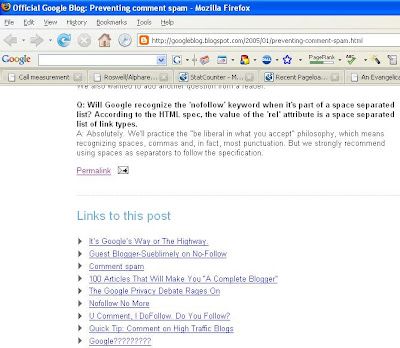
LINK, LINK, LINK! Find a post on the
Official Google Blog and link to it. See what happens. The fact is that each post on the Google blog lists at the end all of the pages that link to that post. It's an automatic "you scratch my back, I'll scratch yours" situation. And if you post about Google and SEO issues often, linkbacks from Google will bring you lots of traffic, because the Google blog itself is a very widely read source. If you post about other things, go ahead and find pages within your subject matter to link to within your posts. Comment on your world within your sphere of influence. This will eventually bring you traffic, as other webmasters and bloggers see your blog on their referral logs and visit your site to see what you're up to, and why you're sending readers their way. You must link to things that are actually relevant, but there is a lot of freedom here. No link is a bad link.
And linking to a blog is better than linking to some website. A blog has an individual author, most likely, who will investigate your site if you send him traffic.
OK, got to go do some work. If I ramble on any more, I may violate my first point!
Labels: blogging, Google, SEO